The biology of belief: why our "why" speaks to us- Part 2
In Part 1 of this series, we explored Simon sinek's powerful golden circle and the importance of communicating our purpose or our why before we explain what we do. We saw that this approach is the difference between a simple sales pitch and a statement of belief that inspires loyalty.
But why is this so effective?
Why are we, as humans, so drawn to leaders and brands that lead with purpose?
The answer is in the biology of the human brain and not a clever marketing trick as it would seem at first glance.
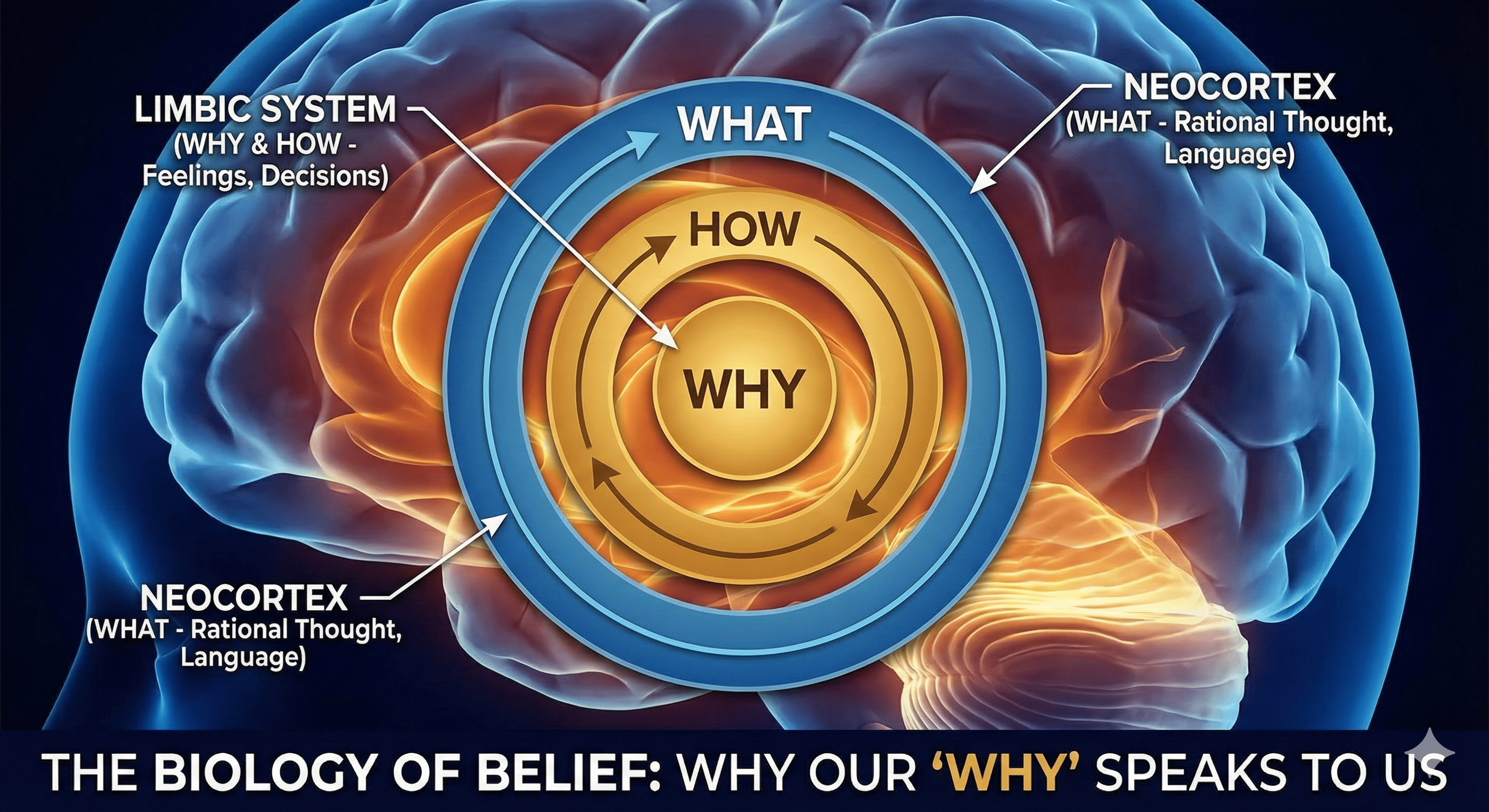
The way Sinek's golden circle is structured mirrors the layout of our brains, and understanding this connection is key to unlocking your influence and inspiration.
The anatomy of influence: how the brain decides
This framework is not based on marketing psychology but on the biology of the human brain. The what corresponds with our neocortex, the newest part of our brain, which is responsible for rational, analytical thought and language. The why and how are linked to our limbic brains, which are responsible for all our feelings, such as trust and loyalty, as well as all human behavior and decision-making.
It is important to note that the limbic brain has no capacity for language. This is where "gut feelings" come from. When a product communicates from the outside in, we will for example be able to understand its features and benefits, but this message will not drive our behavior. When a message communicates the why instead, it speaks to the part of the brain that controls our decisions. It will allow us to rationalize gut feeling with the tangible what the company provides.
From product to movement: leading with purpose
The power of starting with why extends beyond sales. It is the key to inspiring movements and building teams that are driven by more than just a paycheck. Simon Sinek illustrates this with two powerful stories: the Wright Brothers and Martin Luther King Jr.
Samuel Pierpont Langley had what we would consider the formula for success in the race for powered flight: a $50,000 grant from the War Department, a team of the best minds, and media attention. But he was motivated by the what—the desire for fame and fortune. Across the US, Orville and Wilbur Wright had none of these resources, but they were fueled by a powerful why: a belief that flight could change the course of the world. Their team was not working for a salary; they were working for a cause, sweating and bleeding for a shared belief. On December 17, 1903, the Wright Brothers took flight, and Langley, who was not first or rich, quit.
Similarly, Martin Luther King Jr. inspired a movement not by outlining a detailed plan for civil rights, but by sharing his belief. He gave the "I have a dream" speech, not the "I have a plan" speech. He told people what he believed, and the people who believed what he believed made his cause their own. They didn't show up for him; they showed up for themselves and their vision for America.
Are you a leader, or do you lead?
Starting with why is a fundamental principle of human connection that goes beyond a business school aphorism. It explains why some organizations can command deep loyalty and why some leaders can inspire people to action against all odds.
As Sinek concludes, there are leaders who hold positions of power and authority, and then there are those who lead. Those who lead inspire us. We follow them not because we have to, but because we want to. We follow them not for them, but for ourselves.
The challenge, then, is to look inward. What is your why? What is the purpose, cause, or belief that inspires you to do what you do? Once you find it, communicating it clearly is the first step toward not only running a business, but leading a movement.