The KES 62.2 Billion Question: Why Is Mental Health in Kenya So Underfunded, and How Do We Fix It?
In Kenya and across the world, mental health is recognized as a public health and development concern. Increasingly, global conversations are around mental health, and in Kenya, the need has never been clearer. We all have read about the rising cases of depression and anxiety, and the urgent need for support.
So why is it that, a massive gap exits between this acknowledged need and the financial investment required to address it?
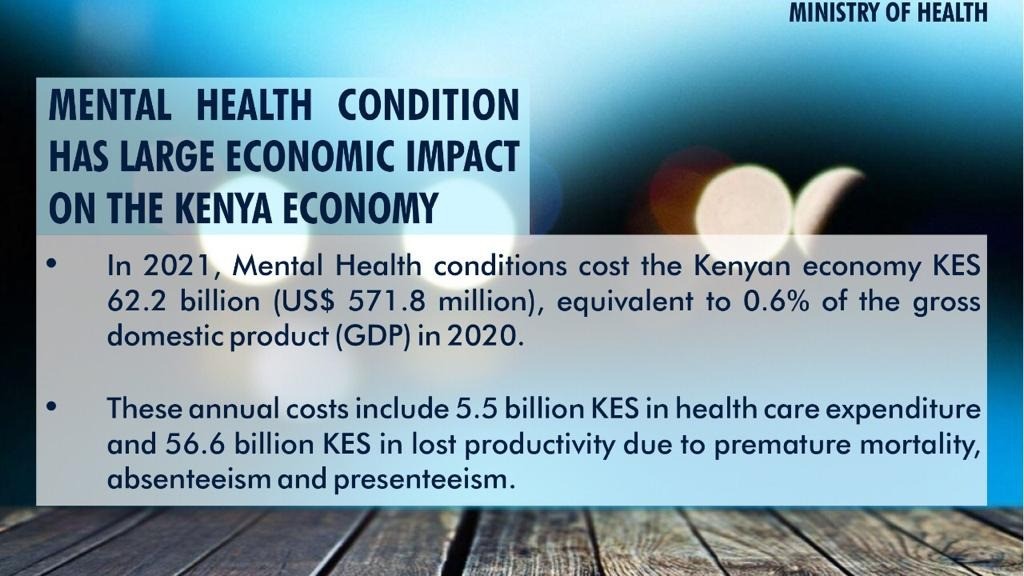
Kenya Mental Health Investment Case revealed that in 2021, mental health conditions cost our economy KES 62.2 billion (equivalent to 0.6% of GDP), primarily through lost productivity. Despite this staggering economic burden, mental health receives a fraction of the health budget, and services remain scarce and inaccessible for the vast majority.
Why does this disconnect exist? And more importantly, how do we bridge it? Based on recent insights, I believe the path forward requires a radical shift from seeing mental health as a cost to be managed, to seeing it as a high-return investment in our nation’s future.
Here is a practical, three-part roadmap to closing the funding gap:
1. Make the Economic Case Irrefutable. The conversation must move beyond a purely social appeal and into the language of economic return. The Kenya Mental Health Investment Case provides this. For example, it projects that for every 1 KES invested in scaled-up treatment for depression, the return on investment (ROI) is KES 4.0 over 10 years. This is a powerful business case that demonstrates investing in mental health is one of the smartest economic decisions we can make.
2. Innovate the Financing Models. Traditional grant funding is not enough to cover the $200B+ global annual mental health financing gap. In discussion in a recent AVPA webinar on Outcome-Based Financing, all the key speakers emphasized the need to shift from paying for services to paying for results. This involves exploring models like Pay-For-Success, where investors fund an intervention and are repaid by government or a larger funder only when measurable outcomes like improved employment or reduced hospital visits are achieved.
3. Build a Whole-of-Society Movement
Data and innovative financial models are essential, but they are not enough. To create the political will for change, we must build a broad social movement. In another a recent webinar on raising public awareness to mobilize domestic resources, public campaigns and advocacy efforts are powerful tools for increasing health financing.
This requires a whole-of-society approach built on two key pillars:
Public Education. Educate the public on the importance of health as a fundamental human right and the need for adequate financing to uphold it. This builds the health literacy required for citizens to engage with and question government spending on health.
Engaging Champions. Find and elevate committed champions for mental health across all sectors of society, especially those with lived experience whose stories can humanize the data and drive action.
Conclusion: This is a Solvable Problem
The mental health funding gap is not an unsolvable crisis. It is a failure that can be corrected with a strategic, multi-pronged approach: making a clear economic case, innovating our financing tools, and building a powerful social movement to demand change. Combining these strategies can move dialogue into action and build a mentally healthy nation.